Networking
Equinox ships a real TCP/IP stack: DHCP and DNS at boot, TCP sockets,
an HTTP(S) client (mget) with TLS 1.2, and a small web server
(httpd). Two NIC drivers are supported: the classic NE2000 ISA
and the Intel E1000 PCI — see DRIVERS.md for the
hardware layer.
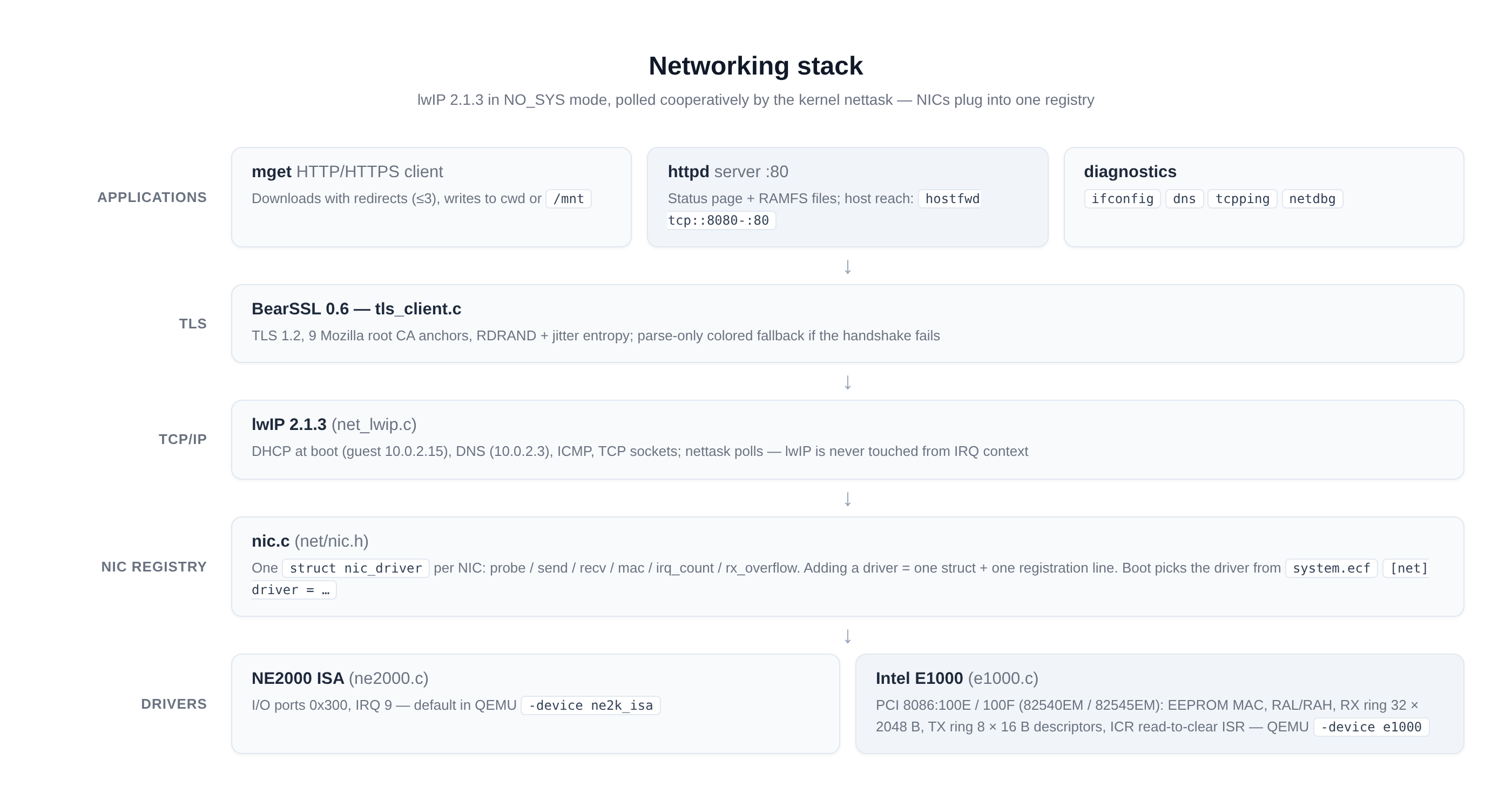
Stack layout
mget (client)   httpd (server :80)   tcpping / dns / ifconfig
        │               │                      │
        └──── BearSSL TLS 1.2 (https)          │
                      │                        │
              lwIP 2.1.3  (NO_SYS, cooperative polling from nettask)
              DHCP · DNS · ICMP · TCP
                      │
              nic.c registry  (probe / send / recv / mac)
              ├─ ne2000.c   NE2000 ISA  0x300, IRQ 9
              └─ e1000.c    Intel PRO/1000 PCI 8086:100E/100F
- lwIP 2.1.3 in
NO_SYSmode: no OS locking; the kernelnettaskpolls the stack cooperatively, and the NIC ISR only ACKs + drains a ring — lwIP is never touched from interrupt context. - BearSSL 0.6 provides TLS 1.2 with 9 Mozilla root-CA anchors and
RDRAND+jitter entropy. If a handshake fails,
mgetfalls back to a parse-only (colored) render rather than crashing. - The NIC registry (
nic.c) is one struct per driver (see DRIVERS.md); the boot driver choice comes fromsystem.ecf([net] driver = …) or registration order.
QEMU user-mode networking
| Fact | Value |
|---|---|
| Guest address | 10.0.2.15/24 (via DHCP at boot) |
| Gateway / host | 10.0.2.2 |
| DNS | 10.0.2.3 |
| ICMP | not forwarded by slirp — use tcpping <host> [port] |
| Host → guest :80 | add hostfwd=tcp::8080-:80 to -netdev, then browse http://localhost:8080/ |
Run variants: make run (NE2000), make run-e1000 (E1000 + install
image). Manual flags are listed in
GETTING_STARTED.md and DRIVERS.md.
The driver choice at boot
net_nic_init() resolves in this order:
system.ecf[net] driver = ne2000 | e1000 | none— written byequinoxinstallphase [3/4] or edited withset;- registration order fallback:
ne2000, thene1000.
Verify with ifconfig (driver name, MAC, DHCP lease, TX/RX counters)
or nettask / netdbg for stack statistics.
Command reference
| Command | Function |
|---|---|
ifconfig |
Interface status: driver, MAC, IP (DHCP), packet counters |
dns <hostname> |
Resolve a name via DNS |
tcpping <host> [port] |
TCP connect probe + RTT (ICMP ping works on real NICs/hardware, not through slirp) |
mget <url> [-port n] |
Download HTTP/HTTPS to the current directory; follows up to 3 redirects — mget https://github.com/octocat/Hello-World |
httpd |
Web server on :80 — status page + RAMFS files |
nettask |
Kernel network task status |
netdbg |
Stack/driver statistics and diagnostics |
Examples
# fetch over TLS (BearSSL) — note https:
mget https://raw.githubusercontent.com/torvalds/linux/master/README

# download straight onto the persistent FAT32 disk
cd /mnt
mget http://10.0.2.2:8022/doom1.wad

# serve the RAMFS to your host browser (make run forwards :8080)
httpd
# host: xdg-open http://localhost:8080/
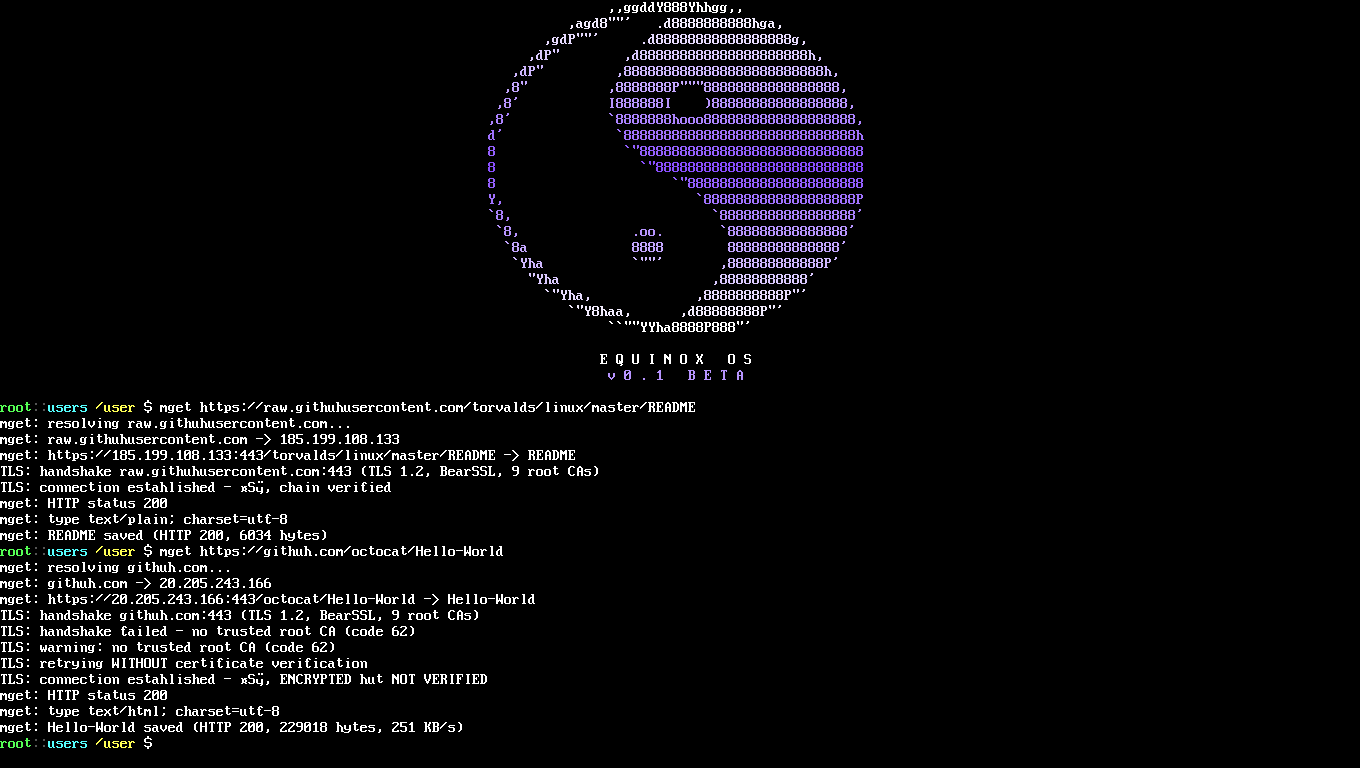
The TLS demo screenshot from the regression suite:
Design notes
- No IRQ-context stack work: the e1000/ne2000 ISR ACKs the
controller and moves descriptors into a kernel ring;
nettaskdoes all lwIP work. This keeps the driver contract trivial and the stack single-threaded by construction. - Zero-copy-ish RX: buffers are pre-allocated 2048-byte descriptor buffers (identity-mapped), handed to lwIP, then returned to the NIC — no bounce copy on the RX path.
- Honest degradation: unrecognized PCI NICs are printed at boot;
TLS failures fall back to parse-only; a missing NIC leaves the system
fully usable offline (
driver = noneis a valid config).