Architecture — technical overview (0.4 Beta)
This document maps how Equinox OS is put together and how it works, from power-on to the OS compiling its own tools. Every concrete number (addresses, sizes, limits) is taken from the current source tree.
1. Boot flow
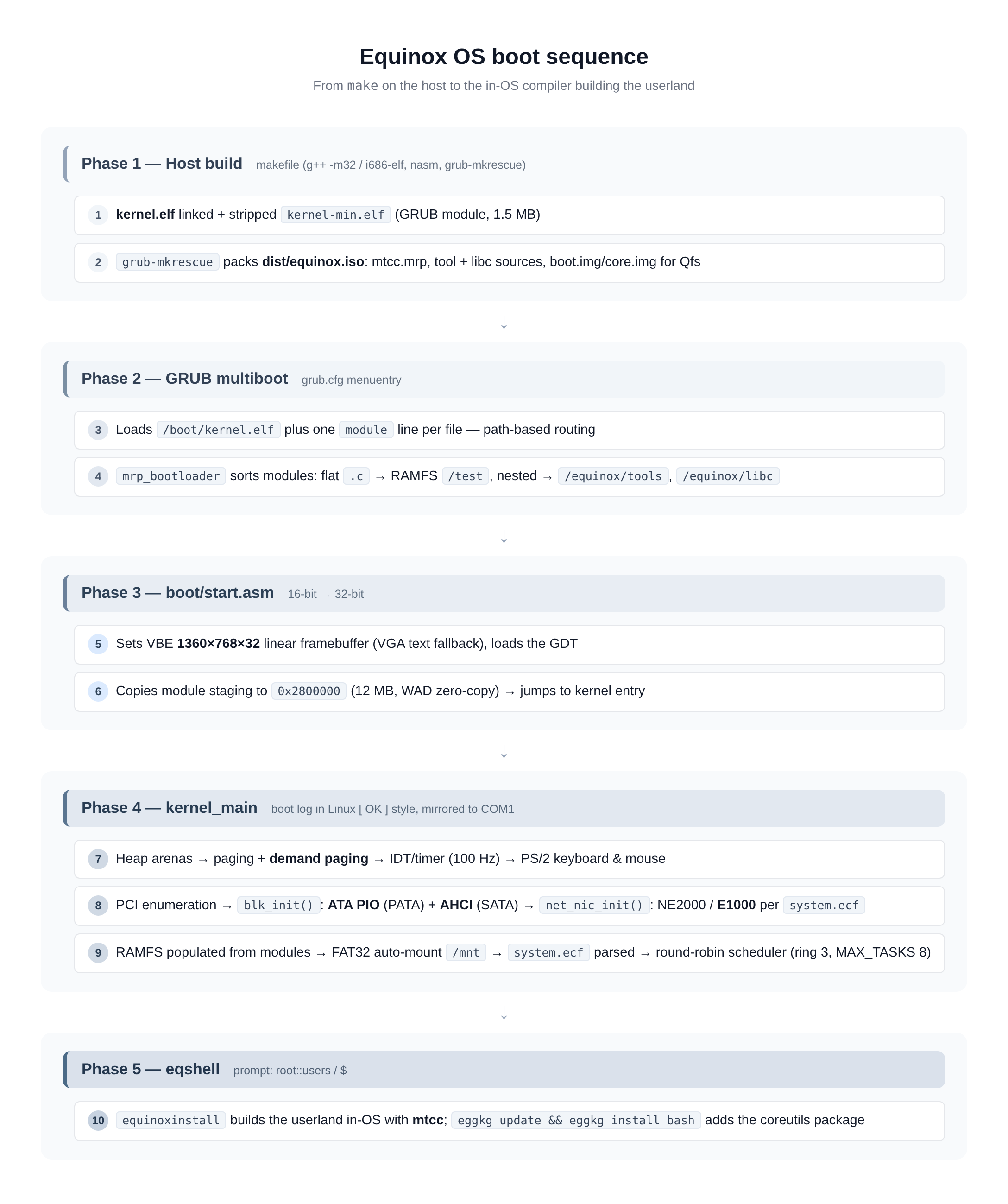
GRUB (ISO, multiboot)
  │  loads kernel.elf + one module line per file (path-based routing:
  │  flat .c -> RAMFS /test, nested -> /equinox/tools, /equinox/libc;
  │  .mrp/.wad by dist/ structure; kernel-min.elf module named
  │  /boot/kernel.elf via cmdline trick)
  ▼
boot/start.asm      — VBE 1360x768x32 (VGA text fallback), GDT,
  │                   module staging at 0x2800000 (12 MB), kernel entry
  ▼
kernel.cpp          — heap arenas, paging + demand paging, IDT/timer,
  │                   PS/2, PCI enumeration, blk_init (ATA PIO + AHCI),
  │                   net_nic_init (system.ecf), RAMFS from modules,
  │                   FAT32 auto-mount /mnt, ecf load, scheduler, nettask
  ▼
shell (kernel/shell.cpp) — prompt root::users / $
  │
  ├─ equinoxinstall -> mtcc (in-OS) -> userland .mrp
  └─ eggkg update && eggkg install bash -> /bin (packages)
The boot log is Linux-[ OK ]-styled and mirrored to serial COM1
(-serial file:serial.log).
2. Source layout
boot/            start.asm (VBE + module staging), grub.cfg template,
                 early.cfg for grub-mkimage (boot.img/core.img)
kernel/
  kernel.cpp     entry + subsystem integration
  shell.cpp      shell, pipes/glob/redirect, eqbash aliases,
                 equinoxinstall wizard, Qfs, set/ecf, es runner
  eggkg.cpp      package manager (update/install/remove/…, SHA-256 verify)
  library/
    drivers/     ata.cpp (PATA PIO), ahci.cpp (SATA), blk.cpp (block
                 layer), ps2_mouse.cpp
    net/…        lwIP glue, ne2000.c, e1000.c, nic.c registry,
                 httpd.c, tls_client.c (BearSSL)
    paging, malloc (2-region), task, syscall, usermode (ring 3),
    fs_ram, fs_fat32(+write, +format), ecf.c, egg_sha256.c,
    elf, mrp_loader, mrp_api, libc, stdio (multi-console + canvas),
    guiarena, UI/ (LVGL apps), equinox_desktop (ThorVG)
mtcc.c           the in-OS C compiler (canonical source)
tools_user/      tool sources shipped on the ISO (text filters;
                 bash-class coreutils intentionally absent)
libc/            libc module sources mirrored for packaging
mrp_user/        Morph.h SDK, mrp_pack.py, elf_link.ld
doomgeneric/     DOOM port -> doom.mrp
third_party/     lwIP 2.1.3 + BearSSL 0.6 (+ root CA anchors)
scripts/         build helpers + QEMU regression harnesses
docs/            this documentation
3. Memory map
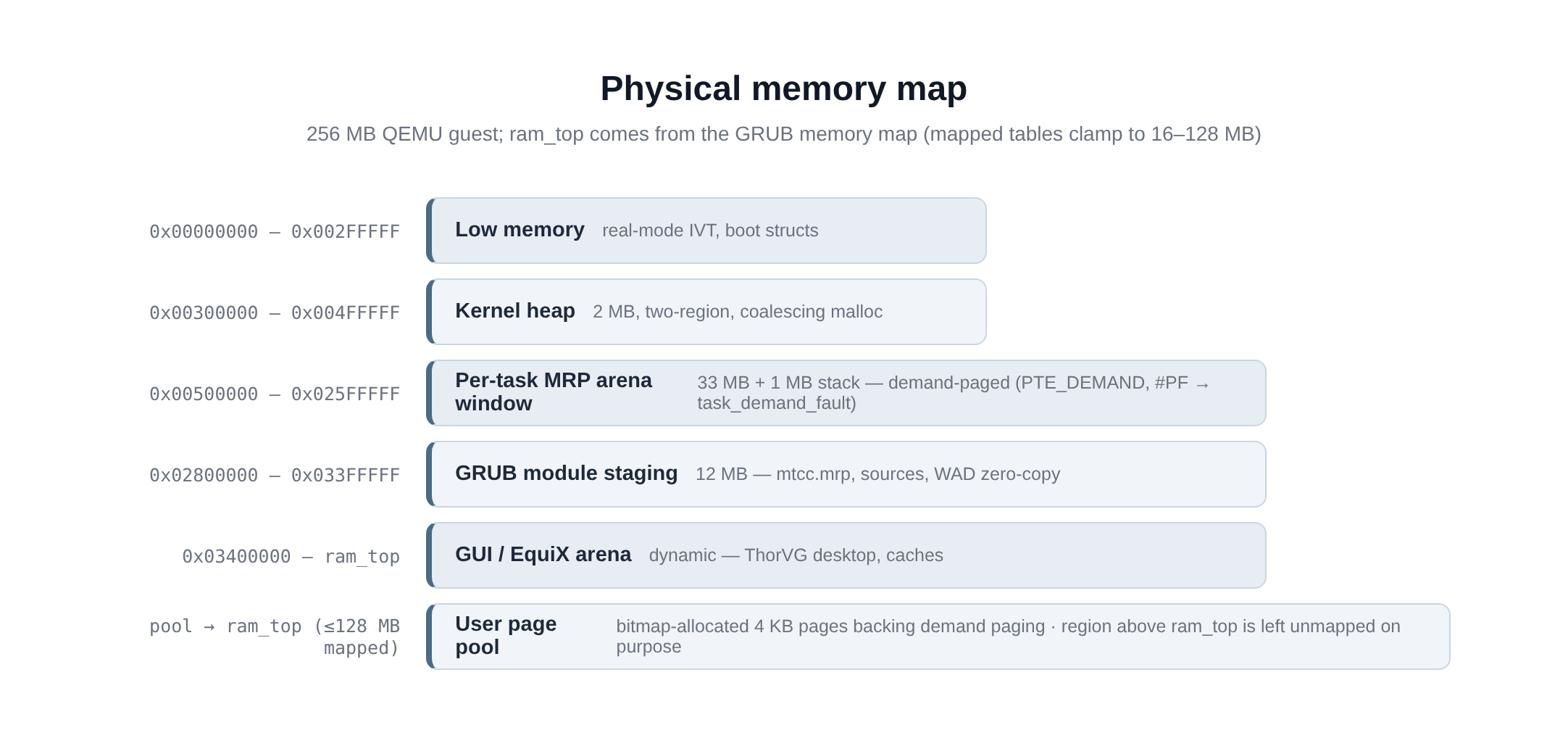
| Area | Address / size | Contents |
|---|---|---|
| Kernel heap | 0x300000–0x500000 (2 MB) + gap ≈1 MB | two-region coalescing malloc; realloc merges only physically adjacent blocks |
| Per-task MRP arena | 0x500000–0x2600000 (33 MB) + 1 MB stack | window reserved via PTE_DEMAND; #PF (isr_14 → task_demand_fault) allocates + zero-fills on first touch; reset per task exit |
| Module staging | 0x2800000 (12 MB) | GRUB modules (mtcc.mrp, sources, WAD — zero-copy) |
| GUI / EquiX arena | 0x3400000 … ram_top | dynamic (follows paging_set_ram_top()); ThorVG desktop, caches |
| User page pool | bitmap-allocated 4 KB pages | backs demand paging |
| RAM top | from the GRUB memory map | page tables = ceil(ram_top/4 MB) clamped 16–32; region above ram_top is left unmapped on purpose |
256 MB guest RAM (-m 256) is the recommended configuration; 64 MB
boots but is tight. Per-task arena layout is guarded by
static_assert against the heap arena structure.
4. Multitasking
- Scheduler: preemptive round-robin at 100 Hz (quantum 1 tick),
FPU state
fxsave/fxrstorper task, ring-3 trampoline entry (TSS; user CS 0x1B / DS 0x23).MAX_TASKS= 8. - Virtual consoles: each task mirrors its own cell buffer + cursor; F1/F2 selects the active console; a background task's printf never overwrites another console.
- Lifecycle:
spawn/spawn2→ exit → child becomes zombie (slot + status held for the parent) →waitreaps; orphans reaped when the parent dies; a full table steals the oldest zombie. - Pipes:
SYS_PIPE4 KB kernel rings, ref-counted ends, inherited across spawn; blocking read/write with EOF and broken-pipe detection. The shell composesgrep … | tr … > filefrom these. - Idle discipline: when everything blocks, the scheduler
hlts with interrupts on — no busy spinning, tick-precise sleeps.
5. System calls
int 0x80, ring 3, append-only table #1–#54 — full reference in
SYSCALLS.md. Groups: console/input, text output, legacy
whole-file I/O, positional fd I/O (open2 with O_CREAT/TRUNC/APPEND/
EXCL/DIR, unlink/mkdir/rmdir/rename/stat/readdir/fstat), memory
(per-task arena malloc/free + meminfo), processes (spawn/spawn2/wait/
kill/taskinfo), pipes, framebuffer + per-task clip/line drawing,
network info/ping, mouse/keyboard events, audio.
Ring-3 pointer arguments are validated by the uaccess check
(SYS_EFAULT). Per-task fd table + cwd + args live in struct Task.
6. Storage & filesystems
- Block layer (
blk.cpp): 8 fixed slots — PATA on 0–3, AHCI on 4+; drivers fill ablk_descwith read/write function pointers. Details in DRIVERS.md. - ATA PIO (
ata.cpp): polling task-file I/O, LBA28/LBA48, IDENTIFY, FLUSH CACHE after writes, sched-locked transfers. - AHCI SATA (
ahci.cpp): ABAR (BAR5), GHC.AE, per-port engine stop/start, DET/ATAPI checks, command list + FIS receive + PRDT DMA, READ/WRITE DMA (EXT), port restart on any failure. - RAMFS (
fs_ram.cpp): in-memory tree populated from GRUB modules;dist/on the host mirrors the layout. - FAT32 (
fs_fat32*.cpp+fs_fat32_format.cpp): read/write with LFN + 8.3 anti-collision mangling, FSInfo, directories grown on-demand, rollback on I/O failure, 8 MB disk cache arena outside the kernel heap; write-through per close.fat32_mkfsformats a whole disk (MBR, type 0x0C @ LBA 2048, label EQUINOXBASE). - Mounting: first FAT32 partition of an IDE disk auto-mounts at
/mnt(lazy RAMFS mirror →ls/cat/edit/mgettransparent); a volume labelled EQUINOXBASE is promoted to root at boot — that is how an installed disk becomes/. - Host-side tested against an mtools oracle + mini-fsck up to 100% utilization.
7. Networking
lwIP 2.1.3 (NO_SYS, cooperative polling) driven by the kernel
nettask; NICs behind the nic.c registry — NE2000 ISA (default)
and Intel E1000 PCI (8086:100E/100F). Driver selection per
system.ecf [net] driver. On top: DHCP/DNS/ICMP/TCP, mget with
BearSSL TLS 1.2 (9 Mozilla root CAs), httpd on :80, tcpping.
Details in NETWORKING.md / DRIVERS.md.
8. Graphics & desktop
- Linear framebuffer 1360×768×32 (VESA DISPI; VGA text fallback with snap-color).
- Multi-console: per-console cell mirror + per-task pixel canvas (first draw snapshots the text screen; exit re-renders it).
- Per-task draw windows:
SYS_SETCLIPclip rectangle (kernel-side intersection),SYS_DRAWLINEBresenham focus-gated. - LVGL 9 apps (file manager, settings, editor) over framebuffer + PS/2 mouse.
- EquiX desktop: ThorVG vector renderer, dynamic GUI arena
(
guiarena.cpp).
9. Executable formats & compiler
- MRP1: flat ring-3 binary + 18-byte header @0x500010; loader
mrp_loader.cpp; per-task arena (demand-paged); morph API (mrp_api, ~20 calls). - ELF32: static
ET_EXECmapped into the demand window;elfdemo.elfbuilt withgcc -m32 -nostdlib -T mrp_user/elf_link.ld. - mtcc (
mtcc.c): lexer → parser → direct x86-32; mini preprocessor splicing<morph.h>etc.; libc subset (printf ≤5 args, sscanf, ctype, qsort, rand); undefined references reported with the call-site line. See SELF_HOSTING.md. - ruf v3 recipes drive
mtcc -make(variables:=, jobs,copy/move ? to) — the eggkg install engine.
10. Configuration & packages
.ecfINI-lite store parsed byecf.c;setbuiltin (get/put/list/-a/-w/-d/-b/-x);system.ecfin/equinox/conf/(legacyboot/fallback) with anactive.confoverlay pointer. See CONFIGURATION.md.- eggkg (
eggkg.cpp): package manager over package.list v0 + index.idx v1 (SHA-256 viaegg_sha256.c), sources →mtcc -makebuild →/bininstall →installed.db+ boot-time.localsync. The bash coreutils are a package, not a bundled component. See PACKAGES.md. - eqshell scripts (
.es): first line[Eqshell], run withset -x, transcript in/eqshell.log.
11. Build & test harness
- Makefile host build (
g++ -m32or i686-elf cross),-MMD -MPdependency tracking; targetsall/run/run-disk/run-img/run-e1000/ run-ahci/diskimg/img/bootimg/pack/mtcc/tools/libc/doom/test. - QEMU regression suites (
scripts/):regression_task3.py(core: boot, tool battery, gfx pixel-proof, libc, soak),regression_task2.py(fstest demand paging, ELF, wait/pipe/zombie),regression_v03.py,regression_multitask.py(canvas/games/F1-F2/DOOM) — 101 checks on a release ISO; plus 0.4 suites:installer_wizard_test.py(blank disk → bootable/),ahci_test.py(17),e1000_test.py,ecf_test.py(25),install_test.py(23),base_img_test.py(15),mnt_build_test.py(7),eggkg_build_test.py(full bash package build in-OS).
12. Design invariants (worth knowing before hacking)
- Syscalls are append-only; #0 stays unused.
- No work from IRQ context beyond ACK + ring-drain (NIC) — the stack and storage both run in task context under sched locks.
- Fixed block slots: PATA keeps 0–3 even if absent; SATA starts at 4.
- The ISO carries sources; the OS builds them. Fresh boot = sources
again =
equinoxinstallis idempotent per session. - The region above
ram_topis deliberately unmapped — wild access faults loudly instead of corrupting silently. - DMA memory is identity-mapped BSS (AHCI/E1000) — keep it that way or add bounce buffers consciously.